loader image

Sustainability Hub

Living in
harmony
with nature

WAZA and its members embrace a world in which every effort is made to live in harmony with nature. By promoting sustainable use of natural resources, progressive zoological organisations are helping their visitors and surroundings communities to take better care of the planet.
The collective power of the global community of zoos and aquariums includes the capacity to reach a global audience, as well as a network of businesses, government agencies and other partners.

Take action
without starting
from scratch

There are many ways in which zoos and aquariums can reduce their environmental impacts and contribute to a more sustainable future. Institutions can take action across a wide range of focus areas to strengthen their environmental sustainability and conservation efforts.
Whether you are launching new initiatives, maintaining existing efforts, or evaluating current programmes, the resources below provide clear guidance and practical examples to help your institution take action without having to start from scratch or “reinvent the wheel.”
If we collaborate and share best practices we will have a more substantial impact on supporting the sustainability, health, and global diversity of our planet.

The WAZA
Sustainability
Strategy

Another strong approach to environmental sustainability starts with understanding your institution’s impacts, setting priorities and identifying realistic actions. An Environmental Sustainability Management Plan (ESMP) can provide the framework to bring these elements together, helping institutions set priorities, track progress and drive continuous improvement.

Environmental
Sustainability
Management Plans

An Environmental Sustainability Management Plan (ESMP) is a structured framework that helps zoos and aquariums, or any organisation identify, manage, and reduce their environmental impacts. It provides a foundation for setting sustainability priorities, identifying realistic actions, tracking progress, and driving continuous improvement. An ESMP can be adapted to any institution, regardless of size, location, or resources, while supporting leadership in environmental sustainability and conservation.
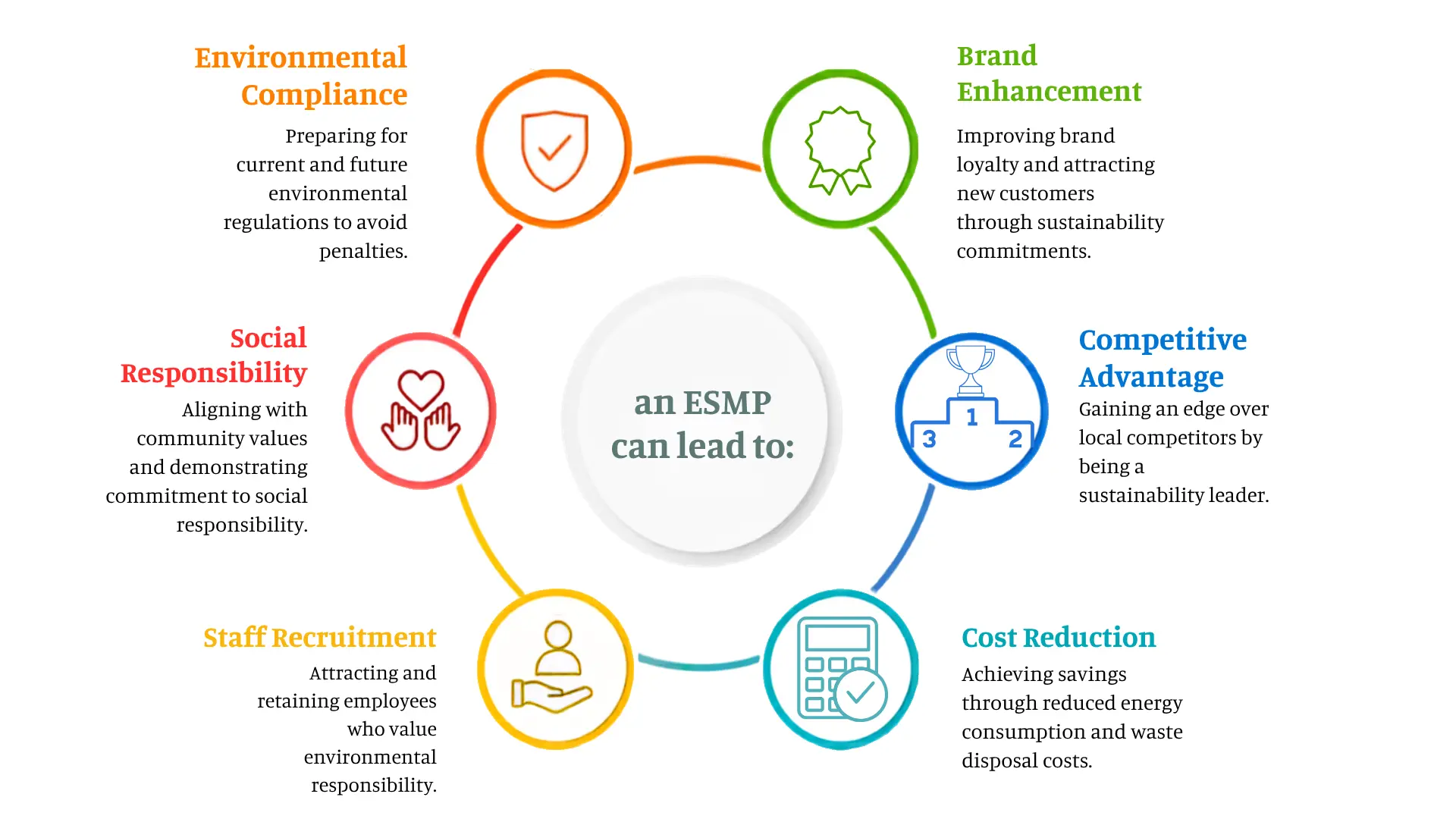
Developing an effective Environmental Sustainability Management Plan (ESMP) at your zoo or aquarium, whether basic or comprehensive, is a crucial step toward more sustainable operations. This effort benefits not only your facility but establishes you as an influential leader in your community. Regardless of size, budget, or location, every zoo and aquarium has a vital role in demonstrating how to reduce environmental impact.

Download our
WAZA ESMP Outline

Learn more

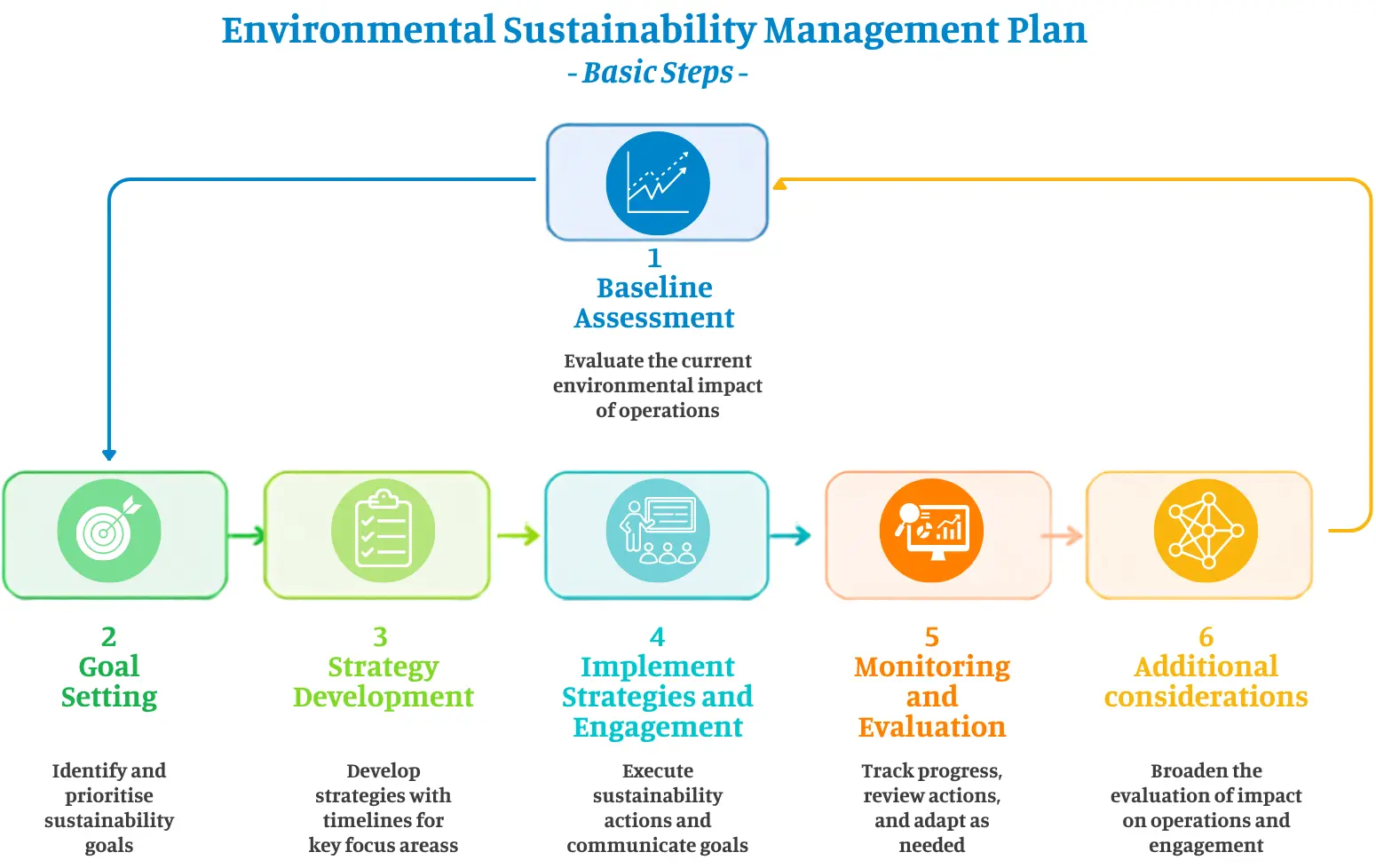
01

Baseline Assessment 

Analyse current environmental impact

Evaluate your organisation’s current energy usage, water consumption, waste generation, carbon emissions, and any other key metrics to understand your baseline footprint.

Identify data gaps

Discover environmental impact categories that don’t have any or enough data for a baseline – then plan and implement projects to obtain necessary data to generate a baseline.   

02

Goal Setting

Establish clear sustainability goals:

Set measurable SMART targets for reducing environmental impact across different areas like energy consumption, waste reduction, and water usage. 

Prioritise goals

Determine which goals are most critical based on your organisation’s environmental impact and capabilities. 

03

Strategy Development 

Develop strategies with clear actions and timelines on your key focus areas in alignment with achieving the sustainability goals you have set. 

General examples

Energy efficiency measures: Audit energy usage and identify opportunities to improve efficiency through energy-efficient appliances, lighting systems, and building controls.
Waste management plan: Develop a comprehensive waste management system including recycling, composting, and waste reduction initiatives. 
Water conservation practices: Implement water-saving measures like fixing leaks, using low-flow fixtures, and rainwater harvesting. 
Sustainable procurement: Source materials and products with minimal environmental impact, considering recycled content and sustainable manufacturing practices. 
Green building practices: Incorporate sustainable design elements into building construction and renovations. 

04

Implement Strategies and Engagement 

Communication

Use communication tools to implement the actions set. 

Employee education and training

Provide employees with awareness and training on sustainable practices within the workplace and the goals set. 

Transparency

Communicate sustainability goals and progress to employees, stakeholders, and the public, and be transparent about progress, challenges and results. 

05

Monitoring and Evaluation 

Track progress

Regularly monitor key performance indicators (KPIs) related to your sustainability goals. 

Review and adapt

Evaluate the effectiveness of sustainability initiatives and make adjustments as needed.

Reporting and transparency

Publish sustainability reports to demonstrate progress and accountability.

06

Additional Considerations 

Evaluate the impact of your operations

Review the implemented strategies and actions on a wider scale and broaden your assessment to include both the inner operations of your institute, and stakeholder experience and engagement.  

Evaluate visitor experience impact

Including direct and indirect benefits. 

Operational efficiency and risk management

Identify areas to maximise resource utilisation and renewability and assess risks associated with them.

Examples

Renewable energy: Transition to renewable energy sources like solar or wind power where feasible. 
Transportation: Optimise vehicle fleet efficiency, promote carpooling, and consider electric vehicles. 
Packaging design: Minimise packaging materials and use recyclable or biodegradable options. 
Supply chain management: Identify key players in supply chain and engage with suppliers to promote sustainable practices throughout the supply chain. 
Biodiversity conservation: Consider actions to protect local ecosystems and biodiversity and identify how your actions and goals can align in supporting broader global biodiversity frameworks. 
Water conservation: review animal life support system equipment, water quality management and maintenance practices to optimise water use efficiency. 
We recommend that all institutions develop at least a basic ESMP. It serves as a foundation for building sustainable infrastructure and identifies realistic opportunities for improvement. While perfection isn’t the goal, this resource helps you begin or advance your sustainability journey.
With almost 300 global WAZA member zoos and aquariums, we have a unique opportunity to connect with local and global communities. With exceptional resources for storytelling and education, we can inspire visitors, employees, and communities to make sustainable choices that support environmental conservation. An ESMP provides essential guidance along this vital journey.

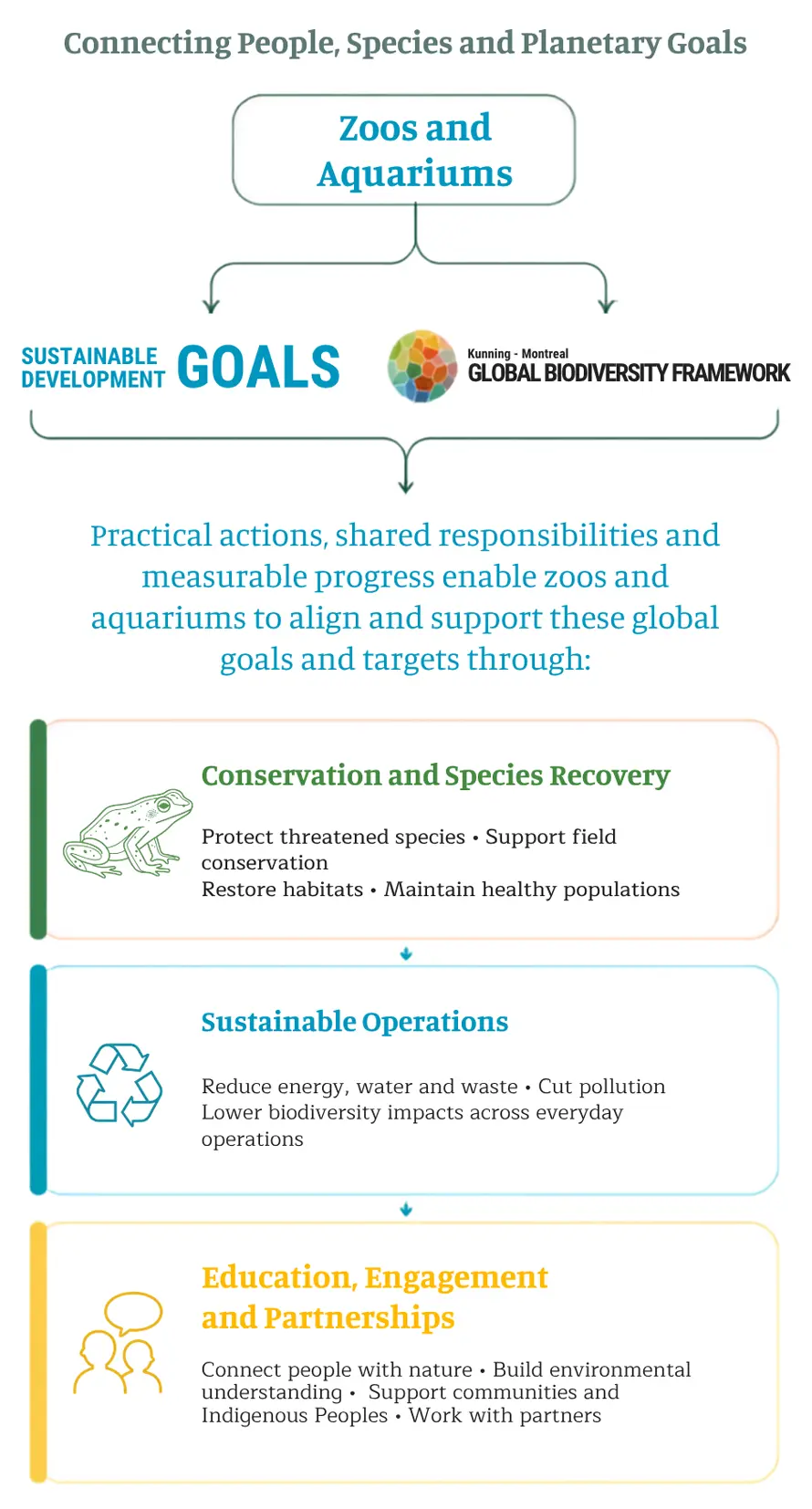
Every zoo and aquarium’s operations from purchasing goods and food to selling products and managing waste connect directly with the 17 UN Sustainable Development Goals and the Kunming-Montreal Global Biodiversity Framework 2030 targets.

The Kunming-Montreal Global Biodiversity Framework (KMGBF) is a global agreement adopted in 2022 that provides a roadmap for halting and reversing biodiversity loss by 2030 and achieving a world living in harmony with nature by 2050. It includes four long-term goals and 23 action-oriented targets, guiding governments and society towards transformative action for nature.
The United Nations Sustainable Development Goals (SDGs) are 17 interconnected global goals adopted in 2015 as part of the 2030 Agenda, providing a shared blueprint for peace, prosperity and sustainability for people and the planet. They address interconnected social, economic and environmental challenges, from poverty and inequality to climate change and biodiversity loss, with the aim of achieving sustainable development by 2030.
Nearly every species exhibited in zoos and aquariums faces environmental challenges in its natural habitat. Species survival worldwide depends on how their environment is affected by human influence, particularly climate change. Institutions that ignore this reality miss a crucial opportunity to be part of the solution and align themselves with wider global frameworks.
Environmental sustainability is an evolving field, and we can achieve more by learning from one another. By sharing knowledge, insights and best practices, WAZA members can help keep these resources relevant and reflect new developments in science, innovation and technology.
Have an example or resource to share for a specific focus area?

Download our case study template and send us your work to conservation@waza.org