
Close
Posted: 20 November 2026
Author: Philip Seddon, Emeritus Professor, University of Otago, New Zealand
When you work in wildlife conservation it can be easy to forget that many people, most people, are unaware and unconcerned about our biodiversity extinction crisis, understandably getting on with their daily concerns and perhaps paying only passing attention to yet another news item about some species or other in decline. The media too tires of nature bad news stories, seeking eyeballs in items that are shocking, or funny, or startling. Global problems, such as climate change, are just depressing, and there is a sense of holding out for some quick techno-fix that won’t require any life-style adjustments. If a nifty techno-fix can be combined with conservation good news, then you can present some truly click-worthy new stories. No wonder then, the huge public interest that has been generated by articles promising not only the end of biodiversity decline, but also the return of long-lost icons of extinction, such as the woolly mammoth and the dodo. “Return of the Mammoth”, “Woolly Mammoth to be Resurrected”, thunder the headlines, and people shake their heads and marvel at what can be done nowadays, and then move on with their daily concerns until the next headline arrives, drip-feeding new breakthroughs, such as the return of dire wolves, the three pups cavorting for the cameras like a scene from Game of Thrones. Have we really solved extinction? Are we on the verge of reaching back into deep time to restore species lost before history? Is de-extinction all hype, or is it a cause for hope? I’m going to try and unpack some of this by giving you my personal perspective.
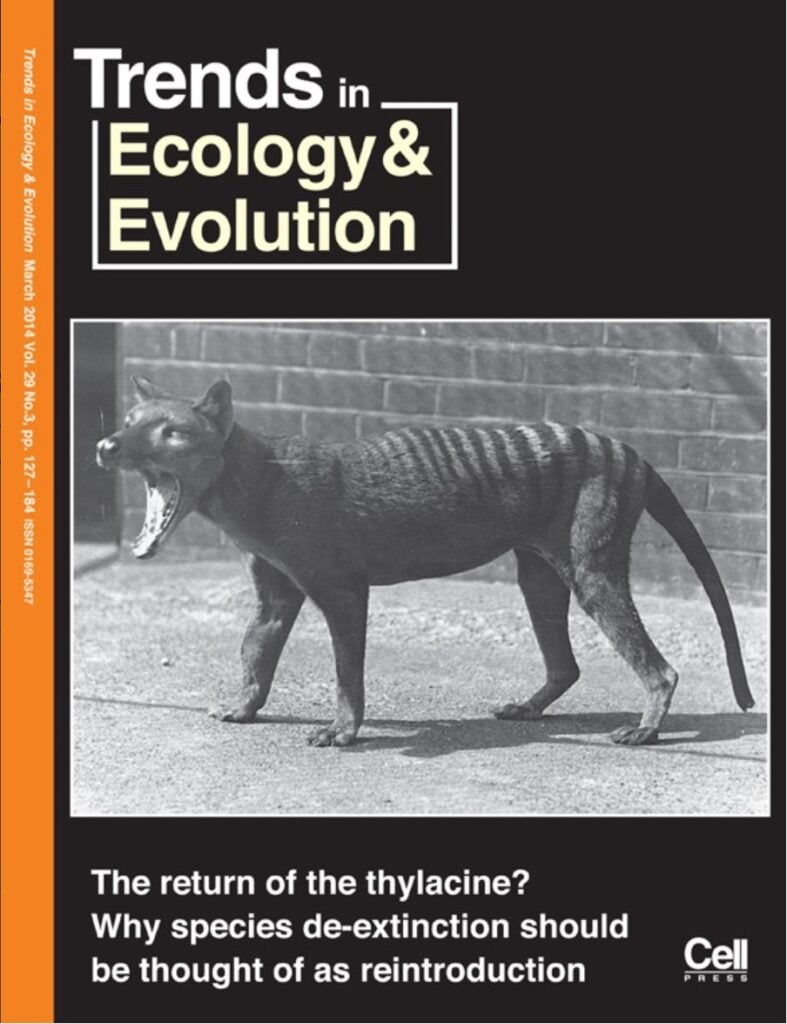
If I had to describe what I do I’d call myself a conservation translocation scientist, a conservation biologist specifically interested in the process of restoring populations of threatened species. An example might be where a species is in decline in one area but doing well in a different part of its range, we could undertake a population reinforcement, moving individuals from the healthy population to bolster the declining one. Or perhaps if a species has disappeared from part of its range but persists elsewhere in the wild, or in captive populations, we could address the cause of the localised extinction and then reintroduce a new population into the vacant habitat by releasing individuals from the captive or the healthy wild populations. Species such as Arabian oryx, Californian condor, and New Zealand kakapo persist only as reintroduced populations. Understandably then, I am deeply concerned with the risks and impacts of species extinctions. I was therefore immediately drawn to a cover-page National Geographic article in 2013 that suggested we now have the ability to bring back extinct species, that de-extinction was a reality. It seemed to me that, if this were true, these resurrected individuals would need to be released to create new populations in suitable habitat somewhere, and this was right in my ballpark. With colleagues I wrote a paper[1] framing de-extinction as a conservation translocation, i.e., the movement and release of individuals to create a population for some conservation benefit. We reasoned that the only point of bringing a species back, if possible, was to restore wild populations, not to create curiosities in a lab or zoo. Soon after that paper came out, I was asked to head an IUCN (World Conservation Union) task force to draft some de-extinction guidelines. With colleagues we delved deeper into de-extinction to better understand what was being proposed and, importantly, what exactly would be produced by this emerging “de-extinction technology”, and also whether this would be good or bad for conservation. The resulting guiding principles[2] made two key determinations: there is no current technical means to fully restore an extinct species, and, nevertheless, creating a functional proxy of an extinct species could have conservation benefits. We therefore avoided the use of the term “de-extinction” as being misleading. So, what are “de-extinction” proponents actually going to be doing?
If you have carefully cryo-preserved living cells of some species it might be possible to use cloning techniques, think Dolly the Sheep. However, if that species is globally extinct and all you have are some cells, your cloning will need a surrogate, a closely related species that could provide a donor cell and a nurturing environment for an embryo. This immediately creates differences from the original species due to such things as mitochondrial DNA inheritance from the surrogate mother, and epigenetic changes. You might get close, but the severing of the evolutionary pathway due to extinction cannot be overcome, and any resulting animal would not be the same as the original species. It gets worse when you reach further back in time to species that went extinct before anyone was creating biobanks of living cells. Cloning is simply impossible for woolly mammoth, dodo, dire wolves, or any other long-lost species. For these you’d need to turn to genetic engineering.
The way it works is this. Using scraps of DNA from preserved tissue you might be able to piece together an approximation of the genome, the full DNA sequence, of the extinct species. The human genome was mapped in a 13-year project that ended in 2003. Technological advances have made genome mapping much, much faster, and more efficient, so you could, not without some effort and funding, assemble a blueprint for an extinct species. But that doesn’t mean you can just make a mammoth, which has over 4 billion DNA base pairs. You need a shortcut, a template to work from. So, you find the nearest relative to a mammoth, the Asian elephant. Mammoths and Asian elephants diverged evolutionarily about 5 million years ago, so their DNA has evolved separately according to the different selection pressures they faced in their environments. But they are still more closely related than are Asian elephants and African elephants. You map the genome of the Asian elephant and then you can compare the two species to see where the DNA sequences are different. Their overall genetic makeup is over 99% identical, but that’s still a lot of base pairs that are different, over a million of them. So, the people working on mammoth de-extinction are aiming to just identify a handful, those relating to what they think are important features, such as long hair, fat under the skin, and blood that functions in the cold. The plan then is to genetically modify an Asian elephant to have some of the mammoth-like features, a mammophant if you will. A GMO elephant. Not a mammoth. The same process is also being proposed for dodo, Australia’s Thylacine (Tasmanian tiger), the giant moa of New Zealand, and the bluebuck of South Africa – to genetically modify some near relative to create a GMO look-alike.
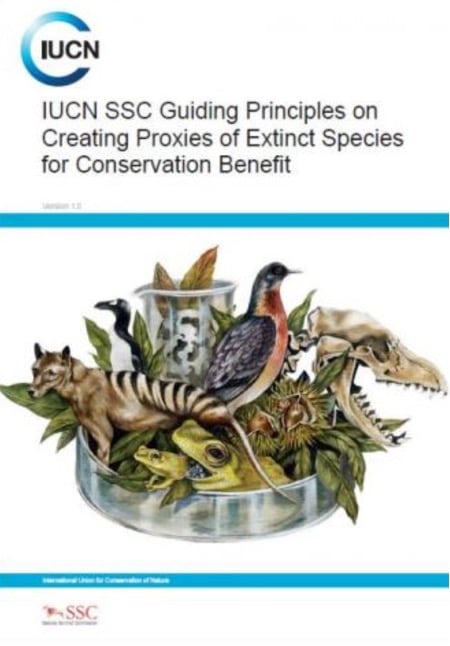
The IUCN Guidelines determined that even if you can’t bring back long lost species, creating a proxy could have conservation benefit if that proxy had the same ecological function as the extinct species. Some species have critical roles in their ecosystems, the way the dig, or trample, or hunt, or forage, creates ecosystem-level changes that support a balance amongst the myriads of other species in that system. The extinction of a critical species creates a gap in the system, the loss of some vital function, and the whole system could collapse. By restoring the lost function with a genetically engineered ecological replacement you could restore the whole ecosystem. That’s the theory anyway. The Guidelines also set up two high hurdles before any de-extinction project should proceed:
Let’s apply some of those principles to a recent high-profile “de-extinction”. In late 2024 breathless headlines announced that dire wolves had been brought back to life with the birth of three pups. Dire wolves were a distinct species of North American canid that went extinct about 10,000 years ago, but which had risen to recent fame as giant white wolves in the fantasy series Game of Thrones. Ok, let’s apply our Guidelines to the dire wolf claims. First – what exactly was done to produce these pups? The nearest living relative of the dire wolf is the grey wolf, near but still millions of base pair differences. Using genetic engineering technicians had compared the genomes of the two species than genetically modified a grey wolf to make it larger and white. That’s it. A big, white grey wolf, a GMO grey wolf. Not a dire wolf. And remember those two questions the Guidelines posed?
Simply put, there was no conservation rationale for creating a genetically modified grey wolf. Cynically put, this was chasing headlines from a credulous and unskeptical media.
Is there any harm in this? Am I just being a killjoy? I think there could be some harm and I’ll explain why, but first I want to state for the record I am a technological enthusiast. I want to see the genetic breakthroughs that will give us new ways to tackle intractable conservation challenges. We are not winning the battle of stemming biodiversity losses and need more tools in our conservation toolkits. But those pushing the new technologies must be honest about what they are doing and the possible risks it might pose, to the welfare of individual animal, to recipient ecosystems, to local communities and indigenous peoples. Creating genetically modified grey wolves is hugely expensive and some have argued that money could be better spent averting extinctions in the first place. An even stronger case against the hype is that it could undermine both faith in science reporting and in the core message of conservation – that extinction is forever. If people believe we have a techno-fix to extinction then the urgency to save species is gone, “we can just bring them back again whenever we want”.
No, no we can’t. Extinction really is forever.
Philip Seddon
Emeritus Professor, University of Otago, New Zealand
[1] Seddon et al. 2014 TREE doi.org/10.1016/j.tree.2014.01.007
[2] IUCN/SSC (2016) “Guiding Principles on Creating Proxies of Extinct Species for Conservation Benefit”
Disclaimer: The views and opinions expressed in this blog post are those of the author and do not necessarily reflect the views or official position of the World Association of Zoos and Aquariums (WAZA).

The World Association of Zoos and Aquariums (WAZA) is the global alliance of regional associations, national federations, zoos and aquariums, dedicated to the care and conservation of animals and their habitats around the world.


